From Cell Models to Cures: How Artificial Intelligence Is Rewriting the Future of Medicine

Introduction
For centuries, medicine has advanced through observation, experimentation, and incremental discovery. From early microscopes to modern genetic sequencing, each leap in technology has brought humanity closer to understanding the building blocks of life. Today, a new revolution is underway—driven by artificial intelligence (AI).
What makes this moment unique is not just the speed of progress, but the depth of understanding AI can provide. Scientists are no longer limited to observing cells; they can now simulate, predict, and manipulate biological systems in ways that were once unimaginable.
The idea that AI can model human cells with high accuracy is more than a technological milestone—it is a gateway to transforming how diseases are understood and treated. If this potential is fully realized, it could reshape the entire healthcare landscape and bring us closer to cures that once seemed out of reach.
Why Cells Hold the Key to Everything
At the core of every disease lies a disruption in cellular function. Whether it’s cancer, neurodegenerative disorders, or infectious diseases, the root cause often begins at the microscopic level.
Understanding cells is incredibly complex because:
- Cells contain thousands of interacting components
- Biological processes are dynamic and constantly changing
- Small variations can lead to vastly different outcomes
Traditional research methods struggle to capture this complexity. Experiments can take years, and results are often limited by the scale of observation.
AI changes this equation by enabling researchers to simulate cellular behavior in digital environments, offering insights that would otherwise take decades to uncover.
What Does It Mean to “Model” a Cell?
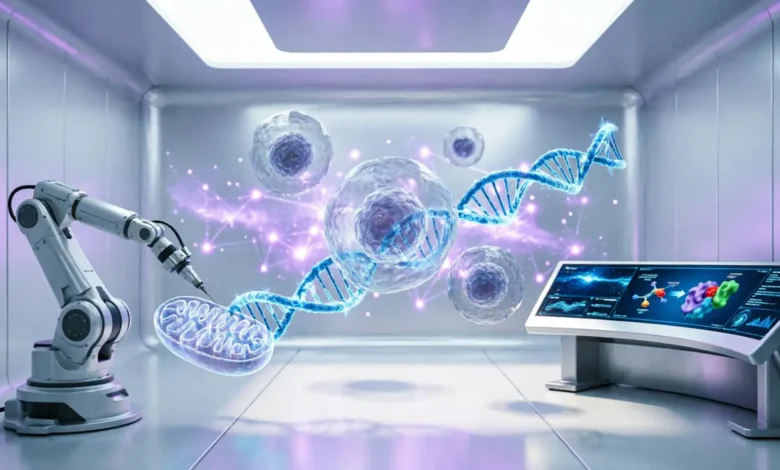
Modeling a cell involves creating a digital representation of its structure and behavior. This includes:
- Gene expression patterns
- Protein interactions
- Metabolic pathways
- Responses to external stimuli
AI systems analyze massive datasets from laboratory experiments and use machine learning to predict how cells will behave under different conditions.
In essence, scientists can now ask questions like:
- How will a cancer cell respond to a new drug?
- What happens if a specific gene is modified?
- How does a virus interact with host cells?
And receive answers in a fraction of the time required by traditional methods.
Accelerating Drug Discovery
One of the most immediate benefits of AI-driven cell modeling is its impact on drug discovery.
Developing a new drug typically takes over a decade and costs billions of dollars. Much of this time is spent on trial-and-error testing.
AI transforms this process by:
- Predicting which compounds are most likely to succeed
- Identifying potential side effects early
- Reducing the need for extensive laboratory trials
By simulating how drugs interact with cells, researchers can narrow down promising candidates much faster. This not only speeds up development but also increases the likelihood of success.
Personalized Medicine Becomes Reality
Every human body is unique, and so is every disease. AI-driven cell modeling allows for a more personalized approach to treatment.
Instead of applying a one-size-fits-all solution, doctors can:
- Analyze a patient’s genetic data
- Model how their cells will respond to different treatments
- Select therapies tailored to their specific condition
This approach is particularly valuable in complex diseases like cancer, where treatment effectiveness can vary widely between patients.
Personalized medicine improves outcomes while reducing unnecessary side effects, making healthcare more efficient and patient-centered.
Understanding Complex Diseases
Some of the most challenging diseases—such as Alzheimer’s, Parkinson’s, and autoimmune disorders—are notoriously difficult to study.
AI offers new ways to explore these conditions by:
- Simulating disease progression at the cellular level
- Identifying early warning signs
- Discovering hidden biological patterns
For example, researchers can model how neurons deteriorate over time or how immune cells mistakenly attack healthy tissue.
These insights could lead to earlier diagnoses and more effective treatments, potentially slowing or even preventing disease progression.
Bridging the Gap Between Data and Discovery
Modern science generates enormous amounts of data. Genomic sequencing, medical imaging, and clinical trials produce datasets that are too large for humans to analyze effectively.
AI acts as a bridge between data and discovery by:
- Processing vast datasets بسرعة فائقة
- Identifying patterns invisible to the human eye
- Generating hypotheses for further research
This ability transforms raw data into actionable knowledge, accelerating scientific progress across multiple fields.
The Role of Collaboration
The advancement of AI in medicine is not happening in isolation. It involves collaboration between:
- Biologists
- Data scientists
- Medical professionals
- Technology companies
This interdisciplinary approach is essential because modeling cells requires expertise from multiple domains.
As collaboration increases, so does the potential for groundbreaking discoveries that could change the future of healthcare.
Ethical and Practical Challenges
Despite its promise, AI-driven cell modeling raises important challenges.
1. Data Privacy
Medical data is highly sensitive, and protecting patient information is critical.
2. Accuracy and Reliability
AI predictions must be validated through real-world experiments to ensure safety.
3. Accessibility
Advanced technologies may not be equally available worldwide, creating disparities in healthcare.
4. Ethical Considerations
Questions about genetic manipulation and AI decision-making must be carefully addressed.
Balancing innovation with responsibility is essential to ensure that these technologies benefit الجميع.
Real-World Applications Emerging Today
AI-powered cell modeling is already being used in several areas:
- Cancer Research: Predicting tumor behavior and treatment responses
- Vaccine Development: Accelerating the design of effective vaccines
- Genetic Disorders: Identifying mutations and potential therapies
- Drug Repurposing: Finding new uses for existing medications
These applications demonstrate that AI is not just a theoretical tool—it is actively shaping modern medicine.
The Future: Toward Predictive Biology
Looking ahead, AI could enable a shift from reactive to predictive healthcare.
Instead of treating diseases after they appear, doctors may be able to:
- Predict
- Prevent conditions through early intervention
- Maintain long-term health through continuous monitoring
This vision represents a fundamental transformation in how healthcare is delivered.
Human Expertise Still Matters
While AI is a powerful tool, it cannot replace human judgment, creativity, and empathy.
Scientists and doctors play a crucial role in:
- Interpreting AI results
- Designing experiments
- Making ethical decisions
The future of medicine lies in collaboration between humans and machines, where each complements the strengths of the other.
Conclusion
The ability of artificial intelligence to model human cells marks a turning point in scientific history. By unlocking the complexity of biological systems, AI is accelerating discoveries, improving treatments, and bringing us closer to cures for some of the world’s most challenging diseases.
However, this progress must be guided by careful consideration of ethical, practical, and social factors. Technology alone is not enough—responsible implementation is key.
As AI continues to evolve, its role in medicine will only grow stronger. The question is no longer whether AI can transform healthcare, but how we choose to harness its potential.
If used wisely, AI-driven cell modeling could usher in a new era of medicine—one defined not by limitations, but by possibility.
FAQs
1. What does it mean for AI to model cells؟
It means creating digital simulations of cellular behavior to study how cells function and respond to treatments.
2. Can AI help cure diseases؟
AI can significantly accelerate research and improve treatment development, but it works alongside human expertise.
3. Is AI already used in medicine؟
Yes, AI is widely used in diagnostics, drug discovery, and medical research.
4. What are the risks of AI in healthcare؟
Risks include data privacy issues, potential inaccuracies, and ethical concerns.
5. Will AI replace doctors؟
No. AI is a tool that supports doctors, not a replacement for human care and decision-making.